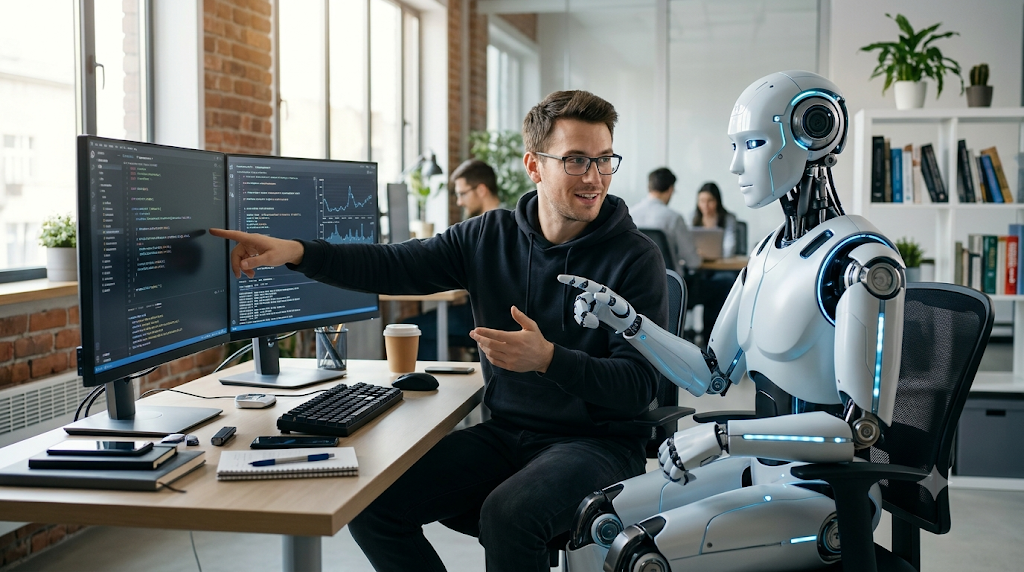
AI Can Help You Build a Website, But for the Long Run You Still Need a Skilled Engineer
AI helps you move faster, while the engineer keeps the system on course, secure and running reliably.
A few years ago, building a website took a whole team. Today you describe what you want in a few lines, and AI hands back an interface, working code and even instructions to put it on a server. That is real progress.
But if your website is a long-term business tool, creating it is the easiest and shortest part of the journey.
1. What can AI do for you?
AI can now help you design the interface, write code, explain errors, guide deployment, and increasingly take part in incident response. For a simple landing page or a prototype, it saves a great deal of time and money.
But that is only one part of a system's life.
2. Creating the website is just the starting line
Stage | Main work |
|---|---|
Analysis | Understand the business, define requirements, choose an approach |
Design | Architecture, database, user flows |
Development | Write code, test, review |
Deployment | Server, domain, SSL, CI/CD, staging and production |
Operations | Monitoring, backups, incident handling, performance tuning |
Maintenance | Software updates, security patches, version upgrades |
Ongoing development | New features as the business evolves |
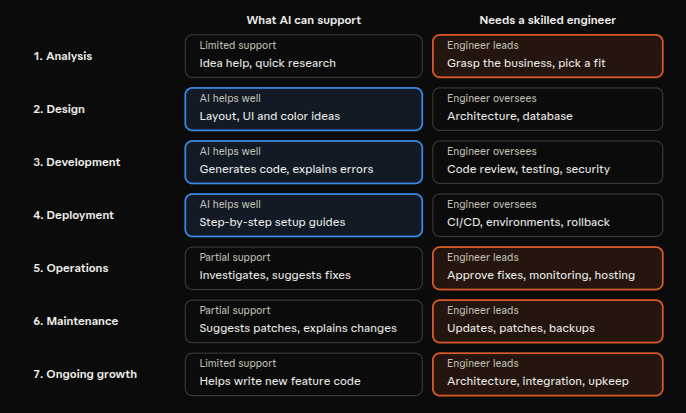
AI helps most in the three middle stages. In the later ones it supports part of the work, while the engineer still approves changes and carries the responsibility.
3. What still needs a skilled person
AI has come a long way in operations: many large companies already use AI agents to investigate incidents and handle repetitive fixes on their own. Even there, changes to live systems usually still need human approval.
Working with your infrastructure provider: opening tickets, understanding their replies, deciding whether to upgrade or switch.
Handling incidents: AI can investigate and propose a fix, but who approves it, who knows when to roll back, and who is accountable if the fix is wrong?
Updates and security: judging whether a new version breaks existing features, testing first, having a rollback plan.
Backups and recovery: do you have backups, and have you ever tried restoring from one?
4. Same AI, different results
AI amplifies skill; it does not replace it.
A skilled engineer asks the right questions, judges the answers, spots risky code early and knows how to fit it into the existing system.
A non-expert tends to accept the first result that runs, without knowing whether it hides a security hole or will cause trouble in a few months.
Code that "runs" and code that is "good enough to operate for years" are two different things.
5. Business owners should focus on the business
Fumbling with technical problems usually costs time, money and opportunity. A business owner's time belongs to product, customers and the market. Handing the technical side to people who do it for a living is not a cost; it is an investment that lets you do your own job well.
6. No website is ever "finished"
Markets shift, customers change, you add products, sales channels and payment methods, and regulations evolve. The software behind your business has to change along with it: it is a living thing that needs ongoing care and development.
7. "If you want to go fast, go alone. If you want to go far, go together."
AI helps you go fast. But once your website is tied to revenue and customer data, you need someone who understands the system, approves changes and is accountable when something breaks.
As AI does more on its own, the question "who approves it, and who is responsible if it is wrong?" matters even more. The sensible approach is to combine both: AI for speed, an engineer for direction, control and operations.
Do you need an engineer by your side yet?
If you answer "yes" to two or more, consider it:
Your website directly generates revenue or handles orders and payments
You store customer data or other sensitive information
You are unsure about backups, updates and security patches
You spend a lot of time on technical issues instead of the business
On the other hand, a simple brochure site or a small shop on a ready-made platform such as Shopify can reasonably be built by yourself with AI.
Frequently asked questions (FAQ)
Can AI completely replace programmers?
Not yet. AI is very strong at writing code and repetitive tasks, but understanding the business, designing architecture, security and long-term accountability still need skilled people.
Is building a website with AI cheaper?
The upfront cost may be lower. Count the hidden costs too: your own time, security risk, fixing mistakes, rebuilding and the damage when the system goes down.
How do I choose a reliable engineer or software company?
Look at real experience, past projects and how they communicate, and above all their ability to stay with you over time, not just deliver a product and vanish.
Conclusion
AI has lowered the barrier to creating a website, but operating and growing it sustainably is a different story. Let AI help you go fast, and keep a skilled partner beside you so you can go far.
If you want to go fast, go alone. If you want to go far, go together.
Need a technical partner for your website or software system? Get in touch with NMC Pro. We take on a wide range of software services, from Shopify and websites to custom systems tailored to your business.
What do you think about building websites with AI? Share your experience in the comments below!
0 Comments
No comments yet. Be the first to share your thoughts!
Leave a Comment